
AI-Driven World
Arnie Jewel writes on the overwhelming inexorability of AI, whether for good or bad.
The world continues to reel along with the doom and gloom foreseen by the Holy Books, science and philosophers. It seems no letup in sight! Everywhere is war! War up north, war down south, war in the east, war in the west…
Similarly, there is still so much hate crime today like in the days of sword and swastika. Like in the days of Jim Crow and apartheid. We better brace up.
So many things seem to happen all at once. And we all seem overwhelmed, but I could be wrong. Some people love the scope and speed of it all. Little wonder Lisa Moore LaRoe once wrote in the National Geographic: “ I love the times we live in People move. Goods move. Cultures change.”
Considering certain contemporary changes and civilizations, you might likely think that this present generation is living in the end times. Are we?
To be sure, under these circumstances, our contemporary society is turbo-charged with movement, luxury, modern lifestyles, science and tech ecosystem including artificial intelligence, AI.
Gone are the days when the world fought wars with bow and arrow as well as with sword, sword and buckler. Dane guns and war chariots were also used. Their frontline or battle formation always resembled an open theatre. But isn’t every battlefield a theatre of war? The answer is obvious.
In the Biblical times, young David was armed with a mere sling shot to kill Goliath, the better-armed Philistine giant and warlord, a far cry from now, when the world fights with sub-machine guns, armoured tanks, smart bombs and long-range missiles.
Specially equipped with artificial intelligence, some of these modern weapons can go the whole nine yard, to destroy their targets wherever they may be on the surface of the earth. Some of them are also heat-seeking missiles that defy conventional or basic principles of bullet travelling in a straight line.
Furthermore, today’s smart weapons can make loops, twists and turns as they go after the body heat or the machine heat of the enemy. Artful dodgers have to be thrice as good to escape being hit by heat-seeking missiles.
Beyond such desperate heat-seeking missiles, many nations have also acquired the dreaded nuclear warheads whose effects are deadlier than those of atomic bombs many times over. Though no nation has yet deployed them in war, their existence has kept the world in suspended terror. People also fear the so-called humane warfare alongside the deployment of nerve gases. In fact, they all spell doom, blood and fire.
To this end, every boot that stamped on the ground along with army uniform soaked in blood has all become potential fuel for fire! Yes, in battle there’s always too much burning and destruction.
Today’s war scenes are no exception to the rule. Of course, today, all the deafening shellings and air raid sirens, and all the sounds of automatic weapons and all the intercontinental ballistic missiles and rockets, represent the Bible reference to the confused noise of the combatants at war.
It doesn’t really matter whether these frightening and confused sounds are made by the ground troops, navy, or air force. They are one and the same thing. Battleground is always about killing fields, confusion, and destruction.
Even when they escape the bullets of hand-held guns, soldiers never know when rocket launchers release nonstop rockets against them. But for a somewhat saving grace, some savvy military today have enough smart bomb interceptors to intercept enemy’s bombs and rockets in midair.
And if to mimic divine air raid, modern warfare also deploy warplanes, drones, and GPS-guided weapons to fight from the skies. GPS always gives the exact location of the enemy to allow the other side hit them square and blue. It’s about using modern technology and AI.
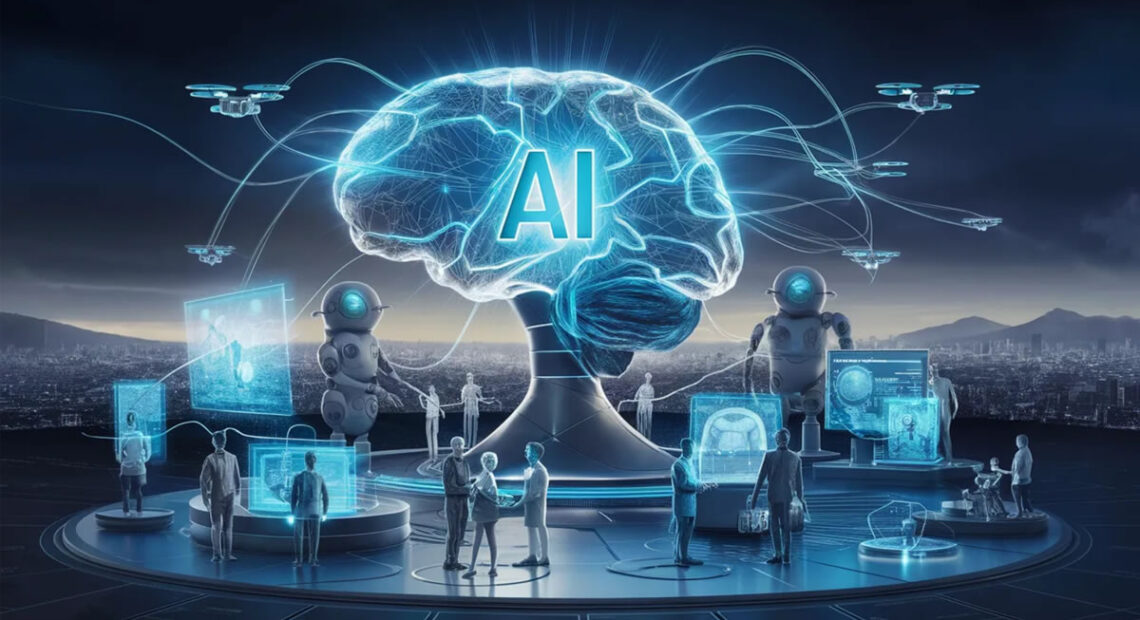
But AI is not all about warfare. Right now my main focus is on how AI connects with our lifestyles and virtually every other aspect of our lives. It goes without saying that in the complex nature of today’s society, AI has stepped up to the plate to foster more comfort, well–being, general convenience, sophistication, safety and security.
Even our natural environment, home and offices have increasingly become AI compliant – with smart cities, smart buildings, smart cars, and smart electronic appliances.
In terms of electronic appliances and beauty technology, it is no longer news that we have things such as voice command entertainment systems, electronic glass shades, digital detoxification, and a range of high-tech beauty gadgets – including “personalized, accessible and downright effective beauty regimens” that usually transform user’s routine “into an art of artistry.”
Think of facial cleansing brushes, LED Light Therapy Masks, smart mirrors, 3D make-up printing, personalized skincare, Virtual Try-on Technology, and Hydrafacial noninvasive skincare.
We also got electronic toothbrush and even things that concern faecal matters including infrared toilet system and even gizmos that can wipe your bum for you. Brrr! Sounds scary, doesn’t it?
Besides such personal hygiene items and beauty stuff “that have brought a high-tech adage to beauty routines,” AI also possess great knowledge about health and fitness. Incidentally, such types of AI are dedicated to help you achieve your goals in these departments.
It goes without saying that such AI has a thorough knowledge of what is best for you and your eating habit and open your eyes to eating properly.
And then again, AI can act as a valuable football coach or football scout by helping teams with which player to hire or sack after thoroughly evaluating his games and performances.
On the other hand, AI-endowed robot can do the most dirty and dangerous work. Incidentally, AI has created several job losses.
While we are still talking about work, AI has also helped us to create hybrid work options. Though there are still brick and mortar offices out there, AI has also enabled Work From Home (WFH) and online activities, Zoom inclusive.
While AI has threatened jobs, the technology has also helped to create hybrid work options. AI equally influences modern travel and tours.
According to Joseph Kithitu, M.D., Hemmingways Travel: “The modern traveler seeks efficiency, personification, and connectivity. AI-driven itinerary suggestions and virtual tours that bring destinations to life are the forefront in embracing tech innovations.”
Hence, “artificial intelligence, virtual reality and augmented reality have become integral to the way people plan and embark on [their] journeys” today.
Somehow, affairs of the heart are also affected by the Internet and AI. For instance, if a mutual appreciation of music genre is something AI thinks is an important factor in a love relationship, then AI would most likely consider the couple as most compatible.
And if they should ever use such assessment as a yardstick to come together as spouses, then it is safe to say that theirs is a love match made in AI heaven! Of course, such things abound on social media and elsewhere courtesy of AI.
Evidently, it seems sheer human decision-making has been taken over by AI. But who takes the blame or responsibility in the situation of failed love relationship? Do men pass the buck on machine? Or how can AI be responsible for human nature and weakness?
And what about mundane matters like lust, love, infidelity, sex and parenting? Or is AI acting in loco parentis natural?
What happens when sophisticated and complex equipment and machines in apparent tip-top working condition suddenly malfunction?
In February 2003, NASA’s shuttle Columbia broke up as it re-entered the atmosphere killing all seven astronauts aboard. Prior to the Columbia accident, the Challenger space shuttle, despite its apparent excellent engineering, several faultless ground tests and guarantees, exploded in midair just 75 seconds after it took off on January 28, 1986 killing all seven crew on board including two American women.
It was the worst accident in the history of space exploration. It reminds you of the plight of the famous ship Titanic once touted as unsinkable, but it did.
As Malcolm Gladwell would ask, who’s to blame for such disasters? Ordinarily, people say accident is one of those things in life—meaning accidents do happen; so we should get used to them. But others argue that accidents don’t just happen.
While we go back and forth in our argument, however we should be sure “that what we learn from one accident can help us prevent another…” says Malcolm. The lesson often helps us reset and create renewed hope.
Under such renewed hope, humanity has continued to learn to entrust their decision and destiny in the hands of such things like AI.
Creative writing and other creative fields are no exception to this reality. With AI, some of today’s writers have had their work well cut out for them. In other words, some writers and authors have harnessed AI to write their books.
But who really takes the credit here – machine or man? For sure, it’s a hybrid but it is more AI’s than man’s.
When AI “hijacks” the work of creatives and does it so well, if not better, who takes the credit?
It goes contrary to the classic quote of John Sheffield: “Of all those arts in which the wise excel, nature’s chief masterpiece is writing well.”
Meanwhile, the quick and fast approach of AI to things matches western idea of someone with high IQ. On the contrary, the Orientals do not consider someone with perfunctory or split-second answers to have a sublime essence.
In their classic philosophy, the fellow with perfunctory answers has not pondered enough on the pros and cons of his answers. Hence, his solution might be fraught with hidden issues.
So they believe a contemplative person has more depth than someone with fast-food-service approach. But it all figures. Fast answers reflect the speed and beauty of artificial intelligence.
Recall, nothing seems to escape the purview of AI. Therefore, it is safe to say that AI is a paradigm shift, the new normal.
Given their nature and lifestyle, Genzers can really relate with the possibilities of AI. So inspiring is AI such that even people in the backwoods also seek to have a piece of the pie.
Granted that AI is all fast, smart and great but somewhere in the middle of all these, there is enough evidence to show that “anything however good may be misused for personal gains.”
No wonder some desperate and dubious people have used similar savvy machine knowledge to commit ATM fraud, Internet fraud or scam. Cyber bully, adult websites and the like also come with the territory.
Be that as it may, it’s still an AI-driven world: From beauty to lifestyle to tourism to aviation to air travel to space travel to maritime to military to medicine to sports to love to business to art and culture – and of course to dubious pursuits.
Simply look at it as the good, the bad, and the ugly. In any case, the 1960s futuristic writers like Marshall McLuhan and Alvin Toffler, the author of The Third Wave saw it coming.
In the final analysis, AI is good. However, AI cannot cater to all our needs. It cannot show you real love and affection. Unlike human, it cannot feel all your pain and sorrows.
It cannot provide all the inner peace you need. It cannot meet your spiritual needs. It cannot grant you salvation.
Only God can….