
Tattoo You, Tattoo Me!
Arnie Jewel writes on the origins, pain and style of the phenomenon of tattoo
“Tattoo has been accepted as an epitome of fashion statement and alternative lifestyle.”
The above caption is synonymous with the British rock band The Rolling Stones. In 1981, The Stones made an album titled, Tattoo You. However, they did not invent tattoo.
As a matter of fact, throughout history, humanity in general has always been in hard pursuit of the enhancement of their physical appearance. Some people are wont to say, “Beauty is heaven sent, but earth improved.” Every culture and generation has her beauty secret.
And then again, some people love to make fashion statement with things like tattoo. But apart from the most common meaning of the word tattoo, there are other meanings including (1) “a military display with music and marching” and (2) “a rhythmic tapping.”
Now let us look briefly at rhythmic tapping. Although we are not actually referring to the sex habit of a certain famous poet who was fond of rhythmic tapping of his lover’s bum for inspiration during congress, there is a link.
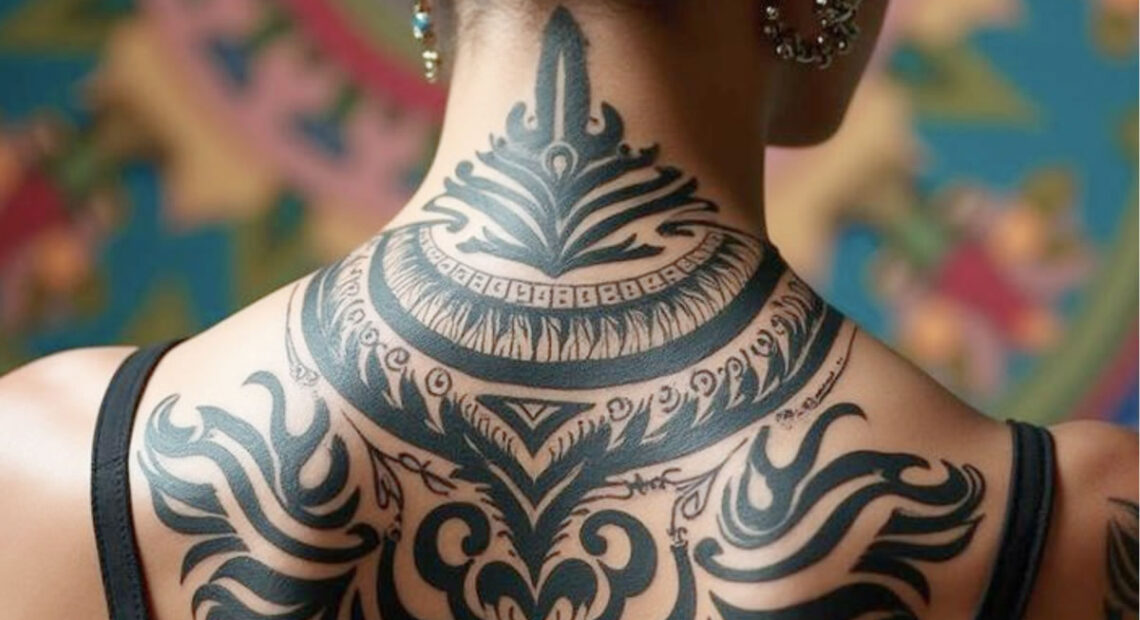
For beauty and sex appeal, some people love to wear a tattoo or two in their intimate parts including the bum. But tattoo can be worn on virtually every part of the body.
Worn on the arm, it is like saying that you’re wearing your heart on your sleeve. It actually represents your fashion statement manifesto. Indeed, tattoo is an epitome of fashion statement and alternative lifestyle.
But it’s more than just a lifestyle. And it might sound obvious to say that tattoo is beauty expression with ancient history and origins.
Tattoo has been accepted as an epitome of fashion statement and alternative lifestyle.
For instance, since the fall of man, women around the world have been known to use beauty treatment and makeup. The Bible makes mention of women like the infamous Jezebel and others who “painted their eyes and adorned themselves with ornaments.”
Moreover, Abraham’s chief servant, Eliezer, on behalf of Isaac, his master’s son, gave Rebecca trousseaus which included jewels of golden earring, bracelet and clothes. Given their love for body adornment and make-up, people of that era probably wore tattoo. At least, different ancient cultures had their respective cultural body designs and products. The Yorubas call the required product lali. Hausa name for it is lalle. The Igbos use uri or uli to create theirs.
But most Akwa Ibom and Cross River people call their tribal tattoo akun. Their women know how to use camwood powder (iduot), turmeric powder or liquid, tree bark and root (adung) to create special tribal tattoo or body art. Other cultures also use henna.
Indeed all of them have something in common with tattoo: they are specially used to decorate the body.
However, tattoo has more global popularity and appeal than the rest. Besides, the overall body use of these other ones is conservative by comparison with tattoo. The latter is more evolutionary and revolutionary. The distinction here is crucial.
In case you don’t know, tattoo is a permanent design made on the skin with a needle and ink. To gain the desired design, tattoo often comes with a degree of pain, what with all that needling and inking on the body. As the saying goes…there is no gain without pain!
Despite such pain, it is happily and increasingly embraced by more people across the world. Simply put, tattoo has gone mainstream. People of diverse backgrounds and occupations now wear a range of tattoos: from just a simple design to the complex to the colourful razzmatazz to the extremes. To be specific, all these have equally taken Nigeria by storm! In Nollywood, it would appear that tattoo was invented for our bright stars, as they flaunt it on and off screens.
All the same, some cultures and religions frown at tattoo. For obvious reasons, WHO does not permit individuals with tattoos to donate blood. Similarly, Islam does not approve tattoo. The Old Testament also warned: “You must not make tattoo markings on yourselves.”
On the contrary, modernity and human tradition openly celebrate tattoo. Their manifesto declares: Tattoo you, tattoo me! In the spirit of such manifesto, many modern Muslims and Christians have lapsed as they have “embraced it with the fervor of a convert.”
Now how can you situate the relation between religion and human logic in this case? In other words, whose report shall we believe? The world of medicine? Religion? Or should we damn the consequences and follow human tradition and trend?
Who really has the last word?